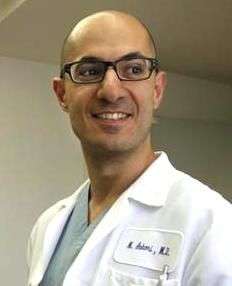
Doctors Name: Mohammad Ashori
License Number: 97831
License Status:
Current - (Dues Paid)
Other State Discipline
Public Reprimand
City of Record: San Diego
Region: San Diego
License issued on: 10/25/2006
Licensing Boards: Medical
Specialties :
General/Family Practice
Gender: Male
Accusations and Infractions or Causes for Discipline:
Discipline By Other State Medical Board
Unprofessional Conduct
Date of Last MBC Action: 04/25/2019
Repeat Offender:
No
Ongoing Discipline:
No
Out of State Discipline:
Yes
No Medical Board Activity:
_____________________________________________________________________________________________________
Medical Board Documents, News Articles, Court Documents, Etc.
| Oregon Stipulated Order 5/30/2018 | |
| Notice of Out of State Suspension 8/13/2018 | |
| Accusation 10/31/2018 | |
| +Decision 4/25/2019 | |
______________________________________________________________________________________________________
Additional Information (Medical School, Dated Actions, Excerpts from Disciplinary Actions, Notes)UNIVERSITY OF CALIFORNIA, LOS ANGELES SCHOOL OF MEDICINE
- 4/25/2019—PUBLIC REPRIMAND.
- 10/31/2018—ACCUSATION FILED.
- 8/13/2018—SUSPENDED-NO PRACTICE PURSUANT TO SECTION 2310(A) OF THE BUSINESS AND PROFESSIONS CODE. BASED ON SUSPENSION OR REVOCATION IN ANOTHER STATE.
Excerpt from Notice of Out of State Suspension dated 8/13/2018:
The Medical Board of California has determined, upon review of certified documents from the Oregon Medical Board, that your Oregon license to practice medicine was suspended on July 12, 2018. Based on this suspension, your California medical license has been suspended effective immediately. This action will be reported to the National Practitioner Data Bank and the Federation of State Medical Boards.
Excerpt from Accusation dated 10/31/2018:
(Discipline, Restriction, or Limitation Imposed by Another State)
8. On or about July 12, 2018, the Oregon Medical Board issued a Stipulated Order (Oregon Order). The Oregon Order found that Respondent engaged in unprofessional conduct. The circumstances are as follows:
9. In May of 2017, Respondent worked occasional clinical shifts at the Kaiser Permanente Urgent Care Clinic [Kaiser Clinic] in Portland and also worked as a physician at the Aurora Clinic (a medical marijuana clinic).
10. One day while at work in the Aurora Clinic in early May 2017, a female co-worker, Patient A, informed Respondent that she had been recently having episodic heart palpitations and that her nurse practitioner told her that she needed to have an electrocardiogram (EKG) done. Patient A did not know what to do. In response, Respondent invited Patient A and another female co-worker to accompany him to the Kaiser Clinic after work to get the EKG done, and afterwards,they could go to a bar for drinks. (Respondent was not scheduled to perform a clinical shift at Kaiser clinic that day}.
11. At the end of their work day at the Aurora Clinic, Respondent and Patient A and a female co-worker drove to the Kaiser Clinic and entered the waiting room of the urgent care clinic, which was crowded with patients waiting to be seen. Respondent escorted Patient A and the co-worker past the check-in desk, and used his Kaiser badge to open the security door, and escorted them both into the clinic area.
12. Respondent subsequently approached the Kaiser Clinic's nurses' station and asked the on-duty Registered Nurse (RN) to perform an EKG on Patient A because she was experiencing heart palpitations. Patient A was not registered with Kaiser as a patient, and had not been checked in at the front desk. The RN protested that Patient A needed to be checked in, that she did not do EKGs, and did not recall from her early training how to perform an EKG.
13. Respondent told the RN that EKGs were easy to perform and urged her to proceed. Respondent escorted Patient A and his other co-worker into a clinic examination room, and left the room. The RN did not record Patient A's name nor record her vital signs. The RN, assisted by a licensed practice nurse (LPN) accessed Google on their cell phones to determine where to place the electrodes, and subsequently attached electrodes to Patient A. The EKG was turned on and a tracing was produced and printed.
14. Respondent inspected the EKG print-out and informed Patient A that she "looked fine." Respondent left the Kaiser Clinic accompanied by Patient A and his other co-worker and subsequently went to a bar for drinks. No patient record was ever created to record the event at the Kaiser Clinic and the EKG record was not retained. The Oregon Medical Board found that Respondent's conduct with respect to Patient A constituted "an improper physician-patient relationship that was contrary to recognized standards of ethics."
15. On or about September 25, 2017, the Oregon Medical Board asked Respondent to identify the two females he brought to the Kaiser Clinic. Respondent declined to provide this information.
16. On or about October 26, 2017, the Oregon Medical Board notified Respondent that he was compelled by statute to provide the identities of the two females he brought to the Kaiser Clinic. Respondent replied to tne Oregon Medical Board that he had reviewed the statute and was not willing to provide the requested information. It was not until November 17, 2017, when the Oregon Medical Board's investigative staff conducted an in-person interview with Respondent, that he finally revealed the requested names. The Oregon Medical Board found that Respondent's refusal to timely provide the identities of the two females subjected him to discipline for failing to comply with a Board request.
17. As a result of Respondent's unprofessional conduct, the Oregon Medical Board issued a letter of reprimand to Respondent, ordered him to pay a civil penalty of $5000.00, and suspended him from the practice of medicine in Oregon for 30 calendar days.
18. Respondent's conduct as set forth above in paragraphs 8 through 17, and the actions of the Oregon Medical Board, as set forth in the Oregon Medical Board Order, constitute unprofessional conduct within the meaning of section 2305 and conduct subject to discipline within the meaning ofsection 141(a). The Oregon Medical Board Order is attached as Exhibit A.
Excerpt from Oregon Stipulated Order dated 5/30/2018:
3.1 In early May of 2017, Licensee worked occasional clinical shifts at the Kaiser Permanente Urgent Care Clinic [Kaiser Clinic] in Portland and also worked as a physician at the Aurora Clinic (a medical marijuana clinic). One day while at work in the Aurora Clinic in early May 2017, a female co-worker, Patient A, informed Licensee that she had recently been having episodic heart palpitations and that her nurse practitioner told her that she needed to have an EKG done. Patient A did not know what to do. In response, Licensee invited Patient A and another female co-worker to accompany him to the Kaiser Clinic after work to get the EKG done, and afterwards, they could go to a local bar for drinks. (Licensee was not scheduled to perform a clinical shift at the Kaiser Clinic that day.) At the end of their work day, Licensee and the two co-workers drove to the Kaiser Clinic and entered the waiting room of the Urgent Care Clinic, which was crowded with patients waiting to be seen. Licensee escorted the co-workers past the check-in desk, and using his pass badge to open the security door, escorted the two co workers into the clinic area. Licensee subsequently approached the nurses’ station and asked the on-duty Registered Nurse (RN), to perform an electrocardiogram (EKG) on Patient A, because she was experiencing heart palpitations. Patient A was not registered with Kaiser Permanente as a patient, and had not been checked in at the front desk. The RN protested that that patient needed to be checked in, that she didn’t do EKGs, and did not recall ftom her early training how to perform one. Licensee told her that it was easy and urged her to proceed. Licensee escorted the two co-workers into a clinic examination room, and left the room. The RN did not record Patient A’s name nor record her vital signs. The RN, assisted by a Licensed Practical Nurse (LPN), accessed Google on their cells phones to determine where to place the electrodes, and subsequently attached ten electrodes to Patient A. The electrocardiogram was turned on and a tracing was produced and printed. Licensee quickly inspected the print-out and informed Patient A that she “looked fine.†Licensee subsequently left the Kaiser clinic accompanied by the two co-workers. They subsequently went to a local bar for drinks together. No patient record was created to record the events at the clinic and the EKG record was not retained. Licensee’s described behavior with Patient A constituted an improper physician-patient relationship that was contrary to recognized standards of ethics.
3.2 In a letter dated September 25, 2017, Licensee was asked to submit a response to the Board. The letter requested in part, the identities of the two females he brought to the Kaiser Clinic. In his response, Licensee failed to provide this information, stating that the females did not want to be identified. On October 26,2017, Board staff left a voicemail for the Licensee regarding this response, informing him that he was compelled by statute to provide the requested information, and referred him to Oregon Revised Statutes 677.190 and 677.320. Licensee returned the call and in a voicemail stated that he had read the statutes and that he would not be providing the identities of the two females. It was not until November 17, 2017, when investigative staff conducted an in-person interview with Licensee that he finally revealed the requested names. Licensee’s refusal to provide the requested information violates ORS 677.190(17).
Excerpt from Decision dated 4/25/2019:
ORDER
Physician's and Surgeon's Certificate No. A 97831, issued to respondent Mohammad Ashori, M.D., is hereby publicly reprimanded.
______________________________________________________________________________________________________